
The Kallis double century mystery solved
by The Editor
 FEATURE: Why did it take so long for Jacques Kallis to score 200? For a long, long time, this was the question on every South African cricket-supporter’s mind. In November 2010, just before he scored his first 200, I did the following analysis which, I think, solves the mystery. Indeed, in retrospect, the way in which Kallis went about getting his first 200 seems to suggest it was correct. It is worth reflecting on today, if only to understand what it was, exactly, he needed to overcome. Read on to find out what it was.
The Kallis double century mystery solved
By: Gareth van Onselen
Follow @GvanOnselen
Follow @insidecrick
6 August 2012
Background
What follows is an analysis I wrote in November 2010, a few weeks prior to South Africa’s first test against India, in which Jacques Kallis broke his 200-run duck and scored 201 not out (his 38th test hundred). It was an attempt to understand why, on so many occasions, Kallis had failed to pass that particular magical mark.
The explanation was a simple one. Put bluntly: by analyzing all his hundreds it was apparent that, if Kallis was not out overnight with a score below 100, the incentive for him to score 100 the next day was such that, inevitably, he would bat for an extended period of time thereafter; the further away from 100, the bigger the incentive. However, if he scored 100 and was not out over night, having achieved the feat, invariably his concentration would lapse the next day and he would be dismissed cheaply.
As it so happened, it was this very hurdle Kallis overcame in scoring his first double ton. He was 102 not out at the end of day 2, and went on regardless the next day to register his first 200. The first time he had ever pushed on after being not out with a 100 overnight.
I think it remains an important insight, somewhat redundant now, but still worth reflecting on. I did submit my analysis to Rapport newspaper (an Op-Ed version of this summary), which it chose not to run. To their detriment I say. Without blowing my own trumpet, had they done so, they would have identified the very obstacle necessary for Kallis to score a double century, just ahead of him conquering it. Perfect timing. It is, to my knowledge, an insight that has not yet been made anywhere.
Introduction
Before I set out my explanation, let me say this: I am an enormous Kallis’s fan. The man is a legend, possibly South Africa’s greatest cricketer; certainly in statistical terms few rival his achievements – for South Africa or, indeed, for any other country. He is the centre that holds. I say this because often Kallis is derided or his contribution downplayed, particularly by the international press, who constantly pile pressure on him to score ‘quicker’, to be ‘more attacking’ and less ‘defensive-minded’. In so doing, they demonstrate nothing more than their own ignorance; for Kallis is a cricketer forged in a classic mould and, without him – the one constant in a decade of change – there is nothing comparable to his great talent around which we might have structured our various teams over the past 15 years.
Summary
Kallis has scored 36 test hundreds. He has never scored a test 200. He has ten hundred scores of 150 or higher. Of these 36 hundreds, on 13 occasions, he was hundred not out overnight. On average, when he continues an innings the following day, not out in excess of 100 overnight, he manages to add just over 14 runs to his overnight score (Table 1).
Only once, out of these 13 occasions, has he managed not to lose his wicket (adding 32 before the innings was declared). Remove that and his average runs-added drops to just under 12. In comparison, if Kallis has not yet achieved a hundred overnight and is not out (this has happened to him 20 times – Table 2), he manages to add an average of just over 119 runs to his overnight score, the following day.
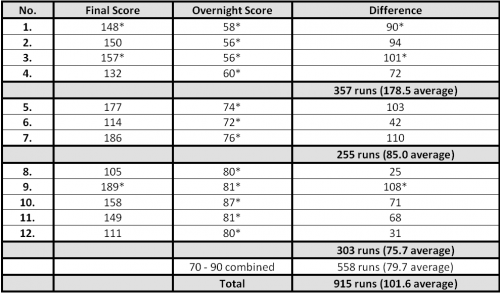
One can disaggregate that statistics further: if Kallis is not out overnight, with his score below 50 (8 times – Table 3), he will add an average of 151 runs to his score the following day; if his score is between 50 and 60 overnight (4 times – Table 4), he will add an average of 178 runs; between 70 and 80 runs overnight (3 times – Table 4), an average of 85 runs and between 80 and 90 runs overnight (5 times – Table 4), an average of 75 runs.
In total, if his score is between 50 and 100 overnight (which has happened 12 times), he will add an average of 101 runs to his overnight score. It can be said then, that on average, the further away he is from a 100 overnight, the more runs he will score the following day.
Conclusion
In summary, if Kallis has achieved a hundred and ends up not out overnight, he scores very poorly the next day (he will add, on average, just 14 runs to his overnight scores). However, if Kallis has not yet achieved this milestone overnight, he will score very well the following day (he will add an average of 119 runs to his score).
It is true that the average number of runs he will add drops the closer his overnight score gets to 100, but the differential between, say, his average added when overnight in the 80s (75) and when overnight on a hundred (14), is so remarkable as to suggest that, once he has a hundred, he is unable or not motivated enough to sustain the kind of concentration he can induce to take him to 100, regardless of his score.
In practical terms, if you were the team captain, your ideal situation would be to have Kallis at the crease and not out on around 30 runs overnight with a full day of batting to come. What you don’t want is for him to get a hundred before the close of play.
TOTAL HUNDREDS
1. 101 Australia (40* – day 4) 1997 – Melbourne
2. 132 England (117* – day 1) 1998 – Manchester
3. 110 West Indies (102* – day 1) 1999 – Cape Town
4. 148* New Zealand (53* – day 2; 58* – day 3; 148*(d) – day 4) 1999 – Christchurch
5. 115 Zimbabwe (101* – day 2) 1999 – Harare
6. 105 England (80* – day 2) 2000 – Cape Town
7. 160 New Zealand (153* – day 1) – 2000 – Bloemfontein
8. 157* Zimbabwe (56* – day1) – 2001 – Harare
9. 189* Zimbabwe (81* – day 4) – 2001 – Bulawayo
10. 139* Bangladesh (107* – day 2) – 2002 – Potchefstroom
11. 105 Pakistan (104* – day 1) – 2002 – Durban
12. 158 West Indies (87* – day 1) – 2003 – Johannesburg
13. 177 West Indies (74* – day 2) – 2003 – Durban
14. 130* West Indies (130*(d) – day 4) – 2004 – Cape Town
15. 130* West Indies (made on day 2) – 2004 – Centurion
16. 150 New Zealand (56* – day 4) – 2004 – Hamilton
17. 121 India (103* – day 1) – 2004 – Kolkata
18. 162 England (13* – day 1) – 2004 – Durban
19. 149 England (81* – day 1) – 2005 – Cape Town
20. 136 England (19* – day 4) – 2005 – Centurion
21. 109* West Indies (1* – day 4) – 2005 – Georgetown
22. 147 West Indies (127* – day 2) – 2005 – St Johns
23. 111 Australia (80* – day 1) – 2006 – Sydney
24. 114 Australia (72* – day 2) – 2006 – Durban
25. 155 Pakistan (118* – day 1) – 2007 – Karachi
26. 100* Pakistan (18* – day 3) – 2007 – Karachi
27. 107* Pakistan (37* – day 3) – 2007 – Lahore
28. 186 New Zealand (76* – day 2) – 2007 – Johannesburg
29. 131 New Zealand (made on day 2) – 2007 – Centurion
30. 132 India (60* – day 1) – 2008 – Ahmedabad
31. 102 Australia (102* – day 2) – 2009 – Cape Town
32. 120 England (112* – day 1) – 2009 – Centurion
33. 108 England (108* – day 1) – 2010 – Cape Town
34. 173 India (159* – day 1) – 2010 – Nagpur
35. 110 West Indies (45* – day 1) – 2010 – St Kitts
36. 135* Pakistan (32* – day 3) – 2010 – Dubai
37. 105 Pakistan (made on day 1) 2010 – Abu Dabi
TABLE 1: Hundreds where hundred not out overnight:
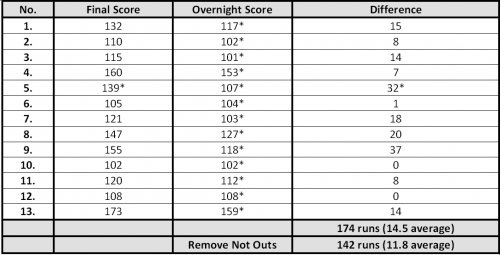
TABLE 2: Hundreds where below hundred not out over night:
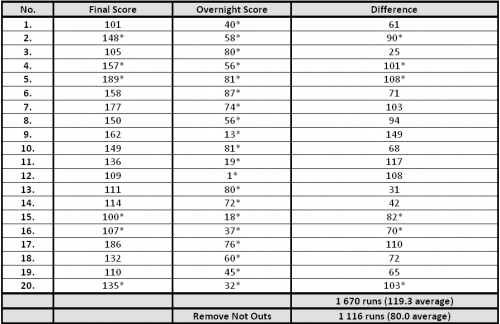
TABLE 3: Hundreds where below 50 not out overnight:
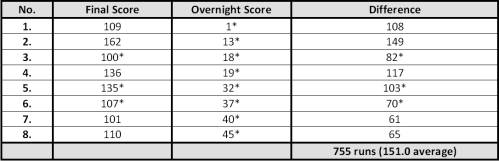
TABLE 4: Hundreds where above 50 but below hundred not out overnight:
To follow Inside Cricket by e-mail simply go to the bottom of the page and fill in your address. When you confirm it, you will receive an e-mail the moment any new post is loaded to the site.
 www.inside-cricket.org
You must be logged in to post a comment.