
Consistency: Why South Africa has been the best Test side over the last 5 years
by The Editor
 FEATURE: South Africa are number one. Horray. Depending on how you measure these things, however, there is a case to be made we have been the best Test side over the past five years; certainly if you use consistency as your measure that holds true. In the article below I look at the performance of the ‘big four’ Test teams – Australia, India, South Africa and England – over the past five years, using the ICC Rankings as a guide and see what that says about each of them in turn.
Consistency: Why South Africa has been the best Test side over the last 5 years
By: Gareth van Onselen
Follow @GvanOnselen
Follow @insidecrick
22 August 2012
Introduction
With their recent Test series victory over England, South Africa rose to first position on the ICC Test Rankings, with 120 points. England, who South Africa displaced at the top, command second place with 117 points and Australia third, with 116 points.
The battle for top spot, over the last five years has been a battle between four teams: South Africa, India, Australia and England. Each has held top spot at least once during this period and the chopping and changing has mostly revolved around key encounters between these four sides.
Much was made of South Africa’s rise to the top and the fact that they beat top-ranked England to get there gave it so much more credibility. Actually though, compared to their own performance, as opposed to that of their opponents, South Africa have achieved a higher rating in terms of points. When they last took over top spot for a brief four months in September 2009, they had secured 122 points.
That fact is significant because it alludes to their consistency. For the three years in-between that occasion and their current position their ICC Test Ranking has never dropped below 116 points and their position on the ICC Table, never below third (in fact, they were only in third position for two months, before returning to second). That is indicative of their performance as a team over the last five years and sets them apart from the others. Truly, when you look at South Africa’s performance over time, it has been the most consistent Test team in world cricket for the past five years.
In order to illustrate the point, I have compiled four graphs, one for each team. For each graph I have collated the respective teams’ ICC Test Ranking at the end of each month since January 2008 and plotted them over time. This way, you can see how a team’s points position has fluctuated (and, logic would suggest, their form too).
For some reason the ICC does not publish its rankings at the end of every month. Sometimes it skips out months. Not many, just one or two here and there. You can find the monthly historical rankings here (2008 here, 2009 here, 2010 here, 2011 here and 2012 here). Where this happened I have acted as if there is no gap, so the plotted line continues uninterrupted. It makes no real difference as it’s the same for everyone. Nevertheless, below each graph, I have included the full data set, should you wish to see what’s missing and the exact points a team had for a given month.
A final point by way of introduction: the graphs don’t have the ICC ranking position the points translate into on them. So it is hard to tell where a team was on the ICC Table at a given point. But, seeing as we are concerned primarily with first place, here is an account of which team has occupied first place over the last five years:
• As of January 2008 Australia (141 pts) through July 2009 (128 pts)
• August 2009 South Africa (122 pts) through November 2009 (122 pts)
• December 2009 India (124 pts) through July 2011 (125 pts)
• August 2011 England (125 pts) through July 2012 (117 pts)
• August 2012 South Africa (120 pt)
Here, then, are the graphs, with some analysis of what they mean.
South Africa
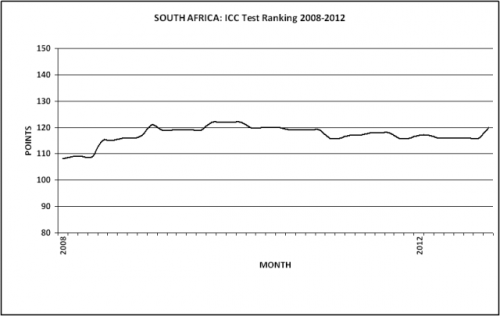
Data Set
2008: JAN 108; MAR 109; APRIL 109; JUNE 109; JULY 115; AUG 115; OCT 116; NOV 116; DEC 117
2009: JAN 121; MAR 119; APRIL 119; MAY 119; JULY 119; AUG 119; SEP 122; OCT 122; NOV 122; DEC 122
2010: JAN 120; FEB 120; MAR 120; JUNE 120; JULY 119; AUG 119; SEP 119; OCT 119; NOV 116; DEC 116
2011: JAN 117; JULY 117; AUG 118; SEP 118; OCT 118; NOV 116; DEC 116
2012: JAN 117; FEB 117; MAR 116; APRIL 116; MAY 116; JUNE 116; JULY 116; AUG 120
Analysis
South Africa’s remarkable consistency is clearly evident. They hover consistently around the 120 pts mark, breaching it for a short period, then flat-lining just below it for a longer period before rising to meet it again with their victory over England. It is the sign of a team that has performed remarkably well against a range of opposition, home and away, over a long period of time. They have never risen above 122 pts and that will now be their goal if they want to consolidate their position, raise the bar and improve further. Significantly, the other three teams have all reached higher marks than South Africa over the five year period: Australia 141, India 130 and England 125. Likewise, they have all reached lower posints too (South Africa 108, India 104, Australia 100, England 98). The collective graphs would suggest you need to get to 125 pts to be safe for a period of time.
England
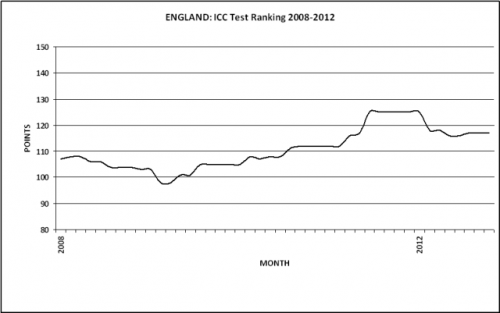
Data Set
2008: JAN 107; MAR 108; APRIL 108; JUNE 106; JULY 106; AUG 104; OCT 104; NOV 104; DEC 103
2009: JAN 103; MAR 98; APRIL 98; MAY 101; JULY 101; AUG 105; SEP 105; OCT 105; NOV 105; DEC 105
2010: JAN 108; FEB 107; MAR 108; JUNE 108; JULY 111; AUG 112; SEP 112; OCT 112; NOV 112; DEC 112
2011: JAN 116; JULY 117; AUG 125; SEP 125; OCT 125; NOV 125; DEC 125
2012: JAN 125; FEB 118; MAR 118; APRIL 116; MAY 116; JUNE 117; JULY 117; AUG 117
Analysis
England bell curve is far less pronounced than India’s, as you shall see. After reaching a low point of 98 pts in March 2009 (the lowest points position of any of the four teams over the past five years) they consistently improved over the next two years before peaking at 125 pts for five months. From there and since January 2012 they have, however, gone into a decline. They have not yet reached the low point they were at before they started to climb (unlike India who have gone past theirs). Whether they can arrest that decline remains to be seen. India travel to England in October.
India
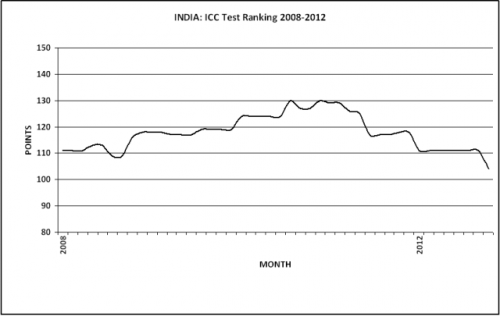
Data Set
2008: JAN 111; MAR 111; APRIL 111; JUNE 113; JULY 113; AUG 109; OCT 109; NOV 116; DEC 118
2009: JAN 118; MAR 118; APRIL 117; MAY 117; JULY 117; AUG 119; SEP 119; OCT 119; NOV 119; DEC 124
2010: JAN 124; FEB 124; MAR 124; JUNE 124; JULY 130; AUG 127; SEP 127; OCT 130; NOV 129; DEC 129
2011: JAN 126; JULY 125; AUG 117; SEP 117; OCT 117; NOV 118; DEC 118
2012: JAN 111; FEB 111; MAR 111; APRIL 111; MAY 111; JUNE 111; JULY 111; AUG 104
Analysis
India’s bell curve is far more pronounced, meaning their rise and decline was quicker. Unlike England they enjoyed a far more rapid assent to number one. After holding steady at around 117 pts for just over a year, they shot up to 124 pts in December 2009 and the number one position. Once they had secured number one, again unlike England, they improved further, all the way up to 130 pts. They held number one for a year-and-a-half, but before they lost the positon in August 2011 their decline began and has been going ever since. From December 2010 (129 pts) India have dropped 25 pts, all the way own to 104 pys in August 2012, their lowest point in five years. Again, whether they can stop the trend remains to be seen.
Australia

Data Set
2008: JAN 141; MAR 141; APRIL 141; JUNE 138; JULY 138; AUG 138; OCT 138; NOV 130; DEC 130
2009: JAN 126; MAR 128; APRIL 128; MAY 128; JULY 128; AUG 116; SEP 116; OCT 116; NOV 116; DEC 116
2010: JAN 119; FEB 116; MAR 119; JUNE 119; JULY 113; AUG 113; SEP 113; OCT 110; NOV 110; DEC 110
2011: JAN 107; JULY 100; AUG 100; SEP 104; OCT 104; NOV 105; DEC 103
2012: JAN 111; FEB 111; MAR 111; APRIL 112; MAY 112; JUNE 112; JULY 112; AUG 116
Analysis
The story of Australia over the past five years is the story of a marked and dramatic decline. In part it is so dramatic because of the amazing heights their team of greats managed to achieve in the early 2000s. And the 141 pts they were on in January 2008 is nothing short of remarkable. As the greats departed, however, so did their form and while their enormous points accumulation was enough to ensure they kept the number position all the way up to July 2009, the numbers are more telling. All-in-all, from January 2008 (141 pts) through July 2011 (100 pts) they lost 41 pts. Since then, they have staged something of a recovery and have improved all the way back up to 116 pts. Perhaps they are rebuilding a new dominating force, perhaps they will level out. South Africa play them in November. Watch this space.
Conclusion
So much attention is placed by the media on the number one Test Ranking that very often we forget to look at consistent performance over time. Yes, it is something special to reach number one, that’s the point of it all, but that approach means one often forgets to take in the bigger picture. A look at the performance of the big four over the last five years suggests that, while various teams have occupied top spot, only one has been consistently excellent. And that team is South Africa.
So, let us all rejoice at being number one but remember too how we got there: by maintaining a longstanding level of excellence. And let’s celebrate that too. Now that we are number one our greatest challenge could well be redefining our own aspirations – to improve in relation to our own previous performances and not just the opposition.
To follow Inside Cricket by e-mail simply go to the bottom of the page and fill in your address. When you confirm it, you will receive an e-mail the moment any new post is loaded to the site.
 www.inside-cricket.org
You must be logged in to post a comment.